
A home office paper system needs more than a place to put a pile. It needs a clear distinction between papers that have just arrived, papers requiring action and papers no longer in active use. Three status groups can establish that distinction without creating a separate compartment for every subject. Choose the storage format after deciding what changes a paper’s status and when you will review it.
Define the three groups in plain language
Incoming is a temporary landing area for papers you have not reviewed. Active holds documents needed for a current task, with the next action identified where helpful. Archive holds papers you have decided to retain but do not need on the working desk. Handle document retention and confidential information according to your own requirements; an organizer does not make those decisions for you.
The groups should describe what happens next, not just where the paper landed. A paper placed in Active without a task can remain there indefinitely. Add a small note or task reference when that helps you remember why the document belongs in the working group.
Choose upright or flat storage by paper shape
Measure the paper and folders you actually use, including covers and projecting tabs. A holder suitable for a bare sheet may not fit a bulky folder. Decide whether each group is easier to browse upright or remove as a flat stack.
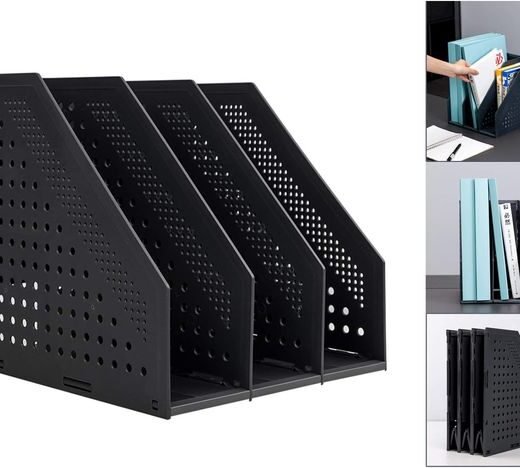
The collapsible three-compartment magazine file organizer provides three vertical sections. It can separate appropriately sized documents and magazines, but check their height and depth against the holder. Place it on a level surface and avoid forcing a thick group into a narrow section.
An upright format can make folder labels easy to scan when they are visible from your normal position. If loose papers lean or disappear behind covers, use appropriate folders or a different format rather than packing the compartment more tightly.
Use horizontal compartments for working stacks
The five-compartment literature and paper organizer has adjustable shelves in a desktop or countertop format. Compare compartment openings with the actual sheet and folder sizes. Leave room above a stack for your hand and allow the supplied assembly and shelf-position instructions to guide the arrangement.
More compartments do not require more status labels. You might use one for Incoming, two for distinct active projects and the remaining sections for another useful working group. The archive can live elsewhere. Avoid turning five compartments into five unexplained piles with no review rule.
Keep small supplies from entering the paper groups
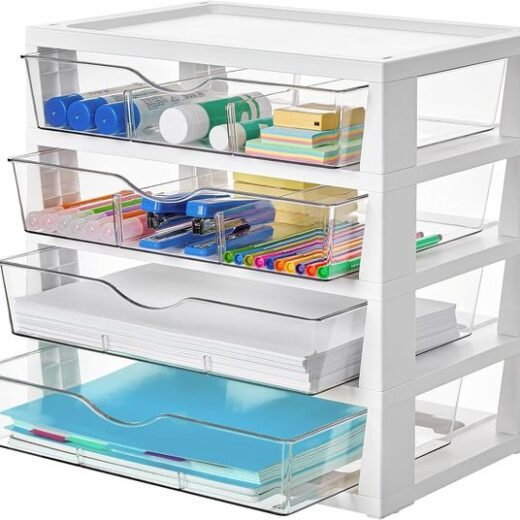
The clear four-tier desk organizer with drawers combines paper levels with drawers for loose supplies. Measure the footprint and the space needed to open the drawers. Check tier openings against paper size instead of assuming every folder fits.
Give clips, labels and similar suitable items their own contained group so they do not scatter across the documents. Keep enough on the desk for current use and store extras elsewhere. The paper system should remain visible without becoming general storage for everything removed from another surface.
Establish a short review cycle
Choose a recurring time in your existing routine to empty Incoming. Read each item, decide its next step and move it to Active, Archive or another appropriate destination. For Active, identify what you are waiting for or what action comes next. Do not use Archive as a second unreviewed landing area.
Keep the working surface clear enough to spread out a current document. The guide comparing horizontal paper trays and upright files helps if the storage orientation is still uncertain. Explore office organization with the paper sizes and status groups already defined.
Test the system with real retrieval
Ask yourself to find a document from each status group. If finding one depends on remembering which unrelated pile it entered, the labels need clearer rules. If the organizer is full after a week, check whether completed active work should move elsewhere. The system succeeds when a new paper has an obvious first stop and a finished task does not remain on the desk indefinitely.
About these guides: RoomSprig uses AI-assisted writing and supplier product information to explain storage choices. Check the selected version, measurements and installation details on the individual product page.