The familiar tower of pans saves shelf space until you need the one at the bottom. Lids disappear behind the stack, handles catch each other, and putting clean cookware away becomes another rearranging job. A better cabinet separates the pieces you use most often and gives each a route out. You do not need every pan displayed upright; you need a layout that matches the shape of your cookware and the way you cook.
Start with an actual cookware inventory
Lay out pans, pots, lids, baking sheets and cutting boards. Pair the lids with the pots they fit. Set aside duplicates and pieces you rarely use, then decide whether they deserve a separate location. This is especially useful when a large roasting pan occupies the best everyday shelf even though you use it only occasionally.
Measure the widest everyday pan, the tallest pot and the longest handle. For upright storage, measure the full height of a lid including its knob. Record these measurements alongside the cabinet opening, not just the cabinet’s interior width. A broad pan may fit inside but still be awkward to carry through a narrow door.
Give flat pieces a different layout
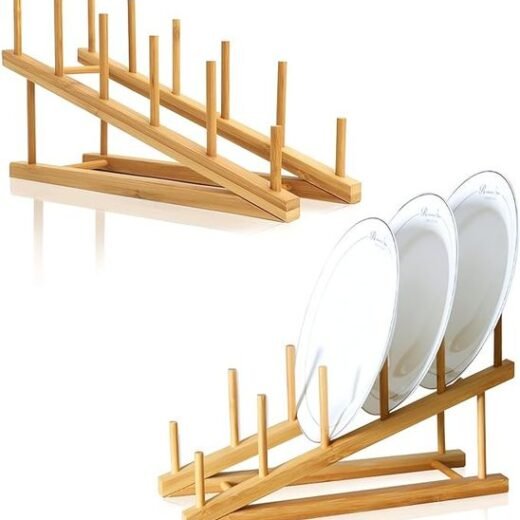
Lids, baking sheets and boards are good candidates for separate slots. Keeping them upright lets you retrieve one without lifting a pile. The bamboo plate and lid organizers come as a pair and can organize plates, lids or cutting boards. Check the space between dividers against the thickness of your items, including thick handles or raised rims.
Try a small group first. A rack beside the cooking area can hold the two boards and lids used most often, while larger bakeware stays elsewhere. Do not force a heavy piece into a narrow slot or let a broad board lean out across the door-opening path. The arrangement should remain stable when the neighboring item is removed.
Decide whether sliding access solves the problem
If your issue is reaching the back, consider a pull-out organizer rather than another stationary rack. The pull-out pan organizer with eight adjustable dividers is listed for a cabinet wider than 10 inches, deeper than 20 inches and taller than 12 inches. The catalog also specifies that it is not suitable for framed cabinets. Those are buying conditions, not optional details.
Check the narrowest opening and the frame around it before comparing the overall interior. Allow room for the organizer to extend and for the handles of stored cookware to pass the hinges. Adjustable dividers help arrange pieces, but they do not compensate for an unsuitable cabinet opening or an installation layout the product does not support.
Use a drawer for a different kind of group
Some collections are better carried forward together on a shallow shelf. A 14-inch soft-close pull-out cabinet drawer can bring stored items forward. Its listed drawer size is 14 by 21 by 3 inches. Installation clearance differs between side mounting and bottom mounting, so use the requirement for the exact mounting method you intend to follow.
A pull-out drawer is not automatically a complete lid solution. Plan dividers separately if needed, and check the product instructions before adding anything to the drawer. Also confirm that pot handles and lid knobs will not rise into the shelf above while the drawer moves.
Arrange around a cooking sequence
Imagine making a typical dinner: take out a pan, find its lid, retrieve a board, and return each after washing. Put the pieces used in that sequence within comfortable reach. Keep occasional bakeware away from the most convenient opening if it interrupts the daily routine. Smaller pans may nest neatly; leave that stack shallow enough to lift without a balancing act.
Photograph the arrangement once it works. That simple reference helps everyone return pieces to the same places. If the cabinet becomes crowded again, revisit the number of pieces before buying another rack.
For cookware, the most useful kitchen storage arrangement is one you can return pieces to easily. For a cabinet that has both reachable and hidden sections, read the blind-corner planning guide before deciding where the cookware should live.
About these guides: RoomSprig uses AI-assisted writing and supplier product information to explain storage choices. Check the selected version, measurements and installation details on the individual product page.