Blind-corner cabinets can hold a surprising amount, but volume is not the same as accessible storage. The hidden section may look generous while the door opening is narrow, a hinge reduces the passage, or a nearby drawer blocks the path of a moving basket. Plan the movement first. A corner organizer should make stored items easier to reach without requiring a new obstacle course outside the cabinet.
Identify the cabinet you actually have
Open the door and look at the route into the hidden section. Note whether the opening is on the left or right and whether a fixed center panel divides the cabinet. Check for a face frame, interior shelves, plumbing, wiring or other obstructions. Take clear photographs of the opening, hinges and interior so you can compare them with the installation instructions.
Do not confuse a blind-corner cabinet with a cabinet designed for a rotating corner shelf. They have different access routes. An organizer’s ability to support left- or right-opening installation does not mean it fits every style of corner cabinet.
Record three sets of measurements
First measure the clear doorway at its narrowest point, including protruding hinges. Then measure internal depth, width and height around fixed obstacles. Finally, measure the open space in front of the cabinet where baskets would move. Include neighboring handles, appliance doors and the normal walkway.
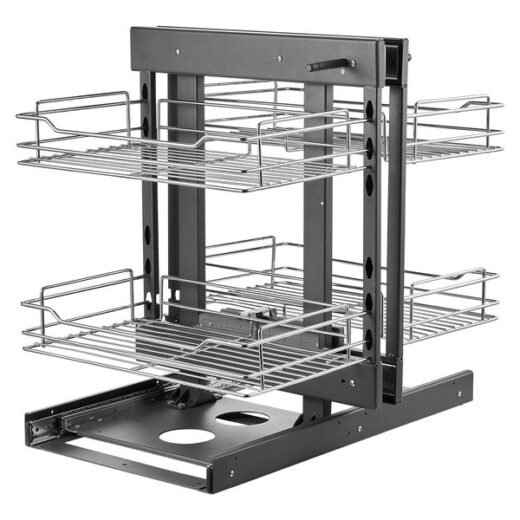
The four-basket blind-corner cabinet organizer is listed at 23.82 by 17.91 by 23.23 inches and supports left- or right-opening layouts. Those overall dimensions are a starting point. Confirm the required opening and full installation arrangement from the product instructions before ordering; fitting the closed frame inside is only part of the check.
Rehearse the movement with a simple outline
Use paper or cardboard to mark the intended floor area and front movement zone. Open every nearby door and drawer through its normal range. Imagine bringing a filled basket forward, then reaching into it. If you would need to stand in an awkward corner or close another door each time, reconsider the layout.
Ask whether the organizer can be installed without removing an important cabinet support or modifying the cabinet in a way the instructions do not cover. Where structural alterations or uncertain mounting are involved, get suitable installation advice before proceeding. An inaccessible fastener or cramped assembly space can be as troublesome as an inadequate door opening.
Choose contents that benefit from the mechanism
Use the corner area for items that are cumbersome to reach but practical to move together: occasional cookware, serving pieces or a clearly grouped collection. Check the supplied loading guidance and distribute contents accordingly. Avoid placing your most frequently used tool behind a sequence of movements when a front shelf could hold it directly.
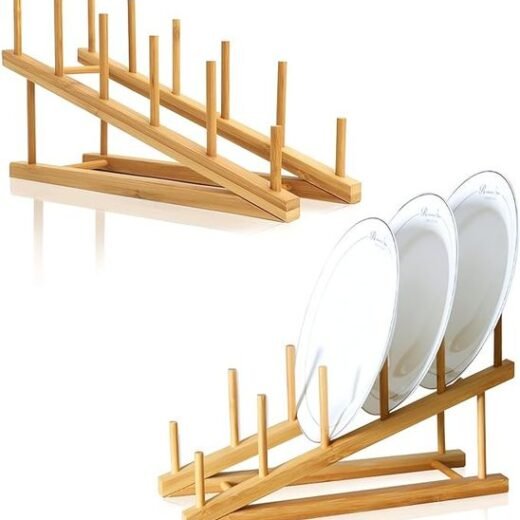
For the reachable cabinet beside the corner, a 14-inch soft-close pull-out drawer may solve a simpler access problem. Its side-mount and bottom-mount space requirements differ, so measure for the chosen arrangement. A pair of bamboo plate and lid organizers can also separate flat items on a stationary shelf if their divider spacing suits the pieces.
Decide whether a simpler change is enough
Before committing to a moving system, try relocating everyday items to the front and occasional pieces to the hidden section. If the corner is rarely opened, that may solve the frustration without adding hardware. If you still regularly reach around stored items, the moving baskets may address a real daily problem.
Finish with a written fit checklist: opening, interior, front clearance, installation side and mounting instructions. Keep the product measurements beside it so the decision is based on your cabinet rather than a staged photograph.
Use those cabinet details when comparing kitchen storage mechanisms. If cookware is your main concern, organizing pots, pans and lids can help you decide which pieces belong in the corner and which need a more direct route.
About these guides: RoomSprig uses AI-assisted writing and supplier product information to explain storage choices. Check the selected version, measurements and installation details on the individual product page.