Over-cabinet-door baskets can add a useful small storage group without taking over the cabinet floor. Their fit depends on more than the door’s width, however. The hooks need suitable thickness and top clearance, the basket needs depth behind the closed door, and the contents must not hit the shelves. Use this checklist to determine whether the door is the right storage location before ordering a set.
Check the door’s construction and thickness
Measure the thickness where the hooks would rest. Look at raised panels, trim and the top edge rather than measuring a different flat part of the door. Read the basket’s mounting instructions to confirm the supported door arrangement. An over-door format is not automatically suitable for every cabinet construction or finish.
Check the top clearance when the door closes. A hook can interfere with a drawer, countertop or cabinet frame above it. Consider any requirements for protecting the finish and removing the accessory; do not assume a hanging attachment guarantees mark-free use.
Measure from the closed door to the nearest obstacle
With the door open, identify the shelf fronts, hinge arms, stored bottles and any other objects behind it. Measure available depth at each height where a basket or its contents would sit. A deep cabinet can still have little clear space immediately behind the door.
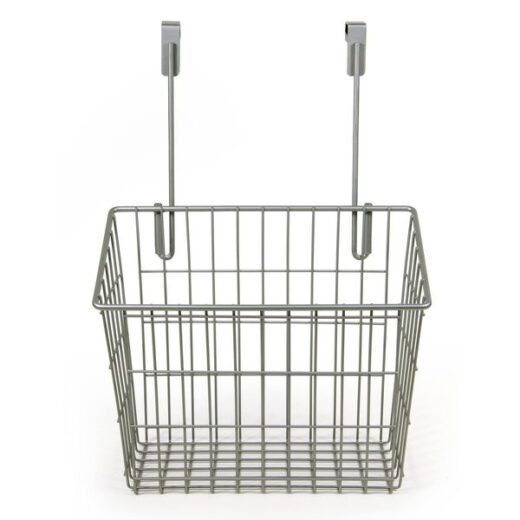
The over-cabinet-door wire baskets come as a set of four. Each has two long hooks, an open metal grid and approximate dimensions of 10.13 inches wide, 6.63 inches deep and 14.5 inches high. Compare the listed form with the door and interior, then confirm the relevant fit requirements in the instructions.
Include the contents in the closing test
Choose the exact group before installation: small cleaning accessories, cloths or another appropriately stored collection. Measure its tallest and deepest item. A tall bottle extending above the basket can meet a shelf even if the empty frame fits comfortably.
Use a cardboard outline to represent the proposed basket and contents. Slowly trace the door’s full movement, including the partially open positions where the basket approaches an interior wall. If the outline hits something, revise the plan. Do not rely on pressing the door shut around a real loaded basket.
Ask whether door storage matches the job
A basket is most helpful when you want to retrieve a defined small group directly at the opening. It is less useful for bulky items or supplies that would block access to the rest of the cabinet. The under-sink storage guide explains how to separate that door group from supplies arranged around pipes.
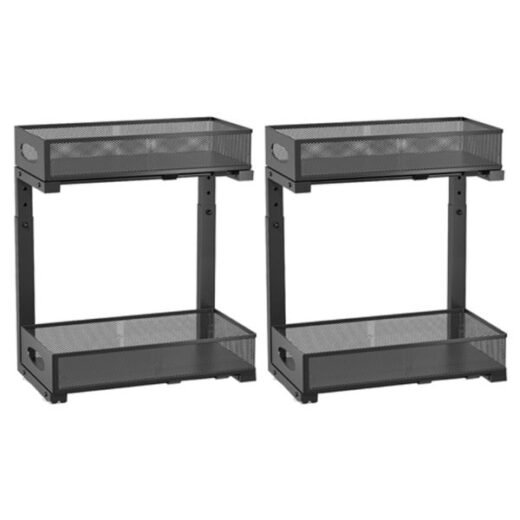
An adjustable pull-out under-sink organizer set is a different approach when the problem is reaching the cabinet floor. Its two rack footprints and adjustable height settings still require a plumbing and opening check. Choose the format for the retrieval problem rather than combining accessories until the cabinet is full.
Compare nearby mounting space if the door fails
For a paper towel roll, an under-cabinet stainless steel holder can use the underside of a suitable cabinet or wall instead. It supports adhesive or screw-mounted installation. Follow the mounting instructions and check roll width, replacement access and surrounding clearance.
A different surface may solve the storage problem without creating a collision behind the door. Compare kitchen storage only after deciding which location can support the intended item and mounting method.
Keep a written pass-or-fail list
Your final checklist should record door thickness, top clearance, empty basket depth, loaded item height, hinge interference and the full closing route. Mark any unresolved requirement rather than treating it as probably fine. Review the supplied loading guidance before filling the basket.
Once installed as directed, test the empty attachment, then add the group gradually. The door should close normally and the contents should remain easy to retrieve. If storage becomes inconvenient after adding one more object, move that object elsewhere rather than expanding the door group until it interferes with the cabinet.
About these guides: RoomSprig uses AI-assisted writing and supplier product information to explain storage choices. Check the selected version, measurements and installation details on the individual product page.